Why Most Digital Marketing Fails (And How AI Changes the Game)
Digital marketing fails not because platforms don’t work.
It fails because most businesses treat marketing as tactics — not a system.
What Is Digital Marketing Failure?
Digital marketing fails when traffic, campaigns, and data are not connected to a unified revenue system.
Many businesses run ads, invest in SEO, and post content — but these channels operate independently. Without conversion optimisation, customer journey design, and retention automation, results become inconsistent and unpredictable.
Marketing activity increases. Revenue stability does not.
Why Does Digital Marketing Fail?
Digital marketing typically fails for five core reasons:
- No unified growth strategy
- Traffic without conversion infrastructure
- Data collected but not activated
- Slow optimisation cycles
- Channel-based thinking instead of system-based thinking
Let’s break these down.
1. No Unified Growth Strategy
Most businesses operate channel-first instead of strategy-first.
They ask:
- Should we run Meta ads?
- Should we hire an SEO agency?
- Should we increase content output?
Instead of asking:
- What is our revenue model?
- What is our cost per acquisition (CPA)?
- What is our customer lifetime value (LTV)?
- What system turns attention into predictable income?
Without a unified revenue architecture, marketing becomes reactive.
2. Traffic Without Conversion Systems
Traffic is not growth.
You can drive thousands of visitors and still fail if you lack:
- Structured landing pages
- Conversion psychology
- Funnel sequencing
- Retargeting logic
- Purchase journey optimisation
Without conversion systems, traffic leaks.
3. Data Exists — But Isn’t Used for Decisions
Most businesses collect:
- Ad performance data
- CRM behaviour
- Website analytics
- Email engagement
- Purchase history
But data alone does not create growth.
Without predictive modelling, segmentation logic, and automated optimisation, data becomes reporting — not intelligence.
4. Slow Optimisation Cycles
Traditional optimisation works like this:
Run campaign → Wait 2–4 weeks → Analyse → Adjust.
By then, budget is already spent.
Slow feedback loops destroy performance.
5. Agencies Optimise Metrics, Not Revenue
Many agencies optimise:
- Click-through rate
- Cost per click
- Impressions
- Keyword rankings
But founders care about:
Predictable revenue growth.
If marketing is not connected to revenue forecasting, it becomes expense management — not growth engineering.
How AI Changes Digital Marketing
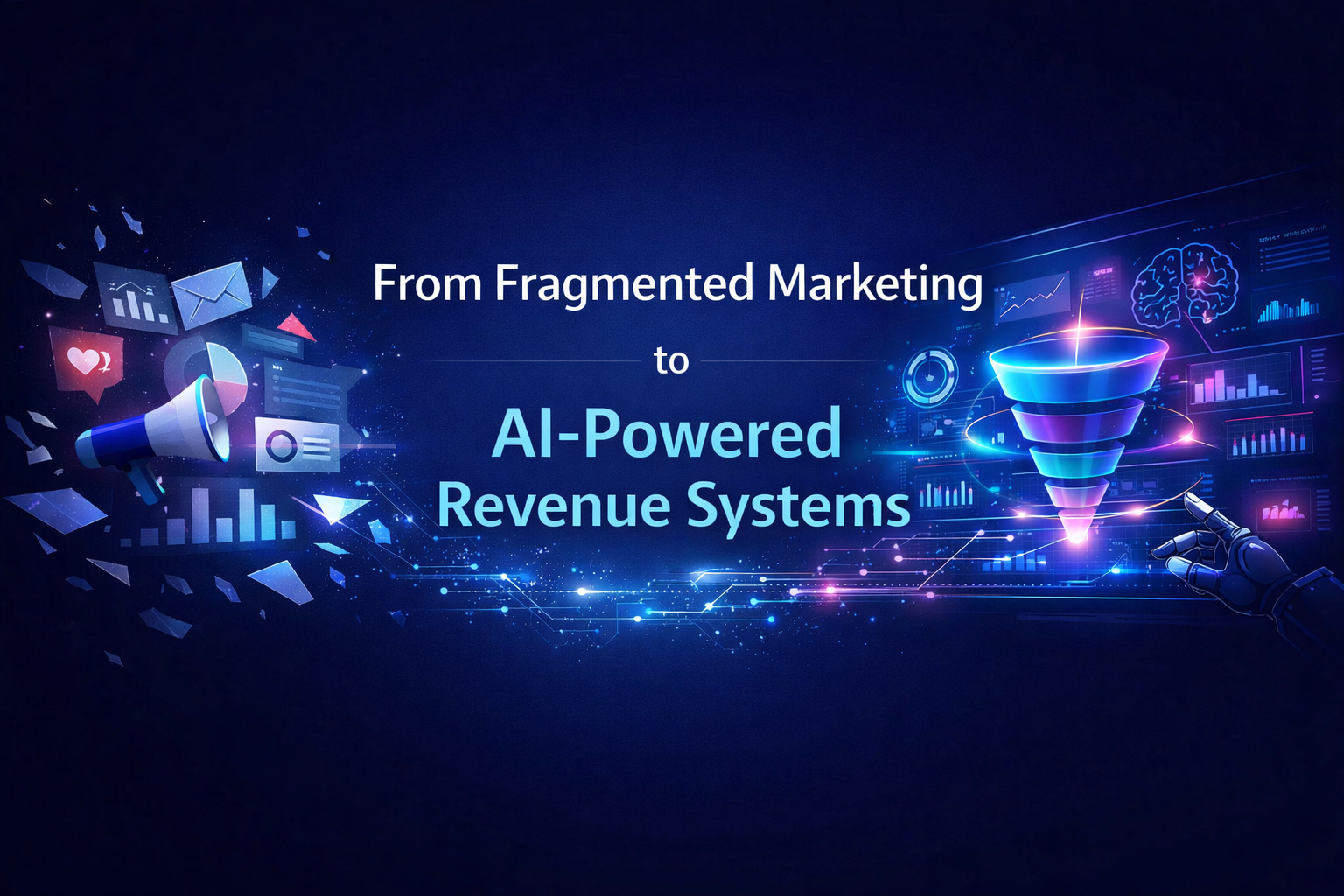
AI changes marketing by turning disconnected tactics into an intelligent, adaptive growth system.
How Does AI Improve Digital Marketing?
AI improves digital marketing by:
- Predicting customer behaviour
- Automatically adjusting ad bids
- Identifying high-value audience segments
- Personalising user journeys
- Forecasting revenue outcomes
- Detecting funnel leakage in real-time
Instead of manual guesswork, AI enables continuous optimisation.
What Is an AI-Powered Revenue System?
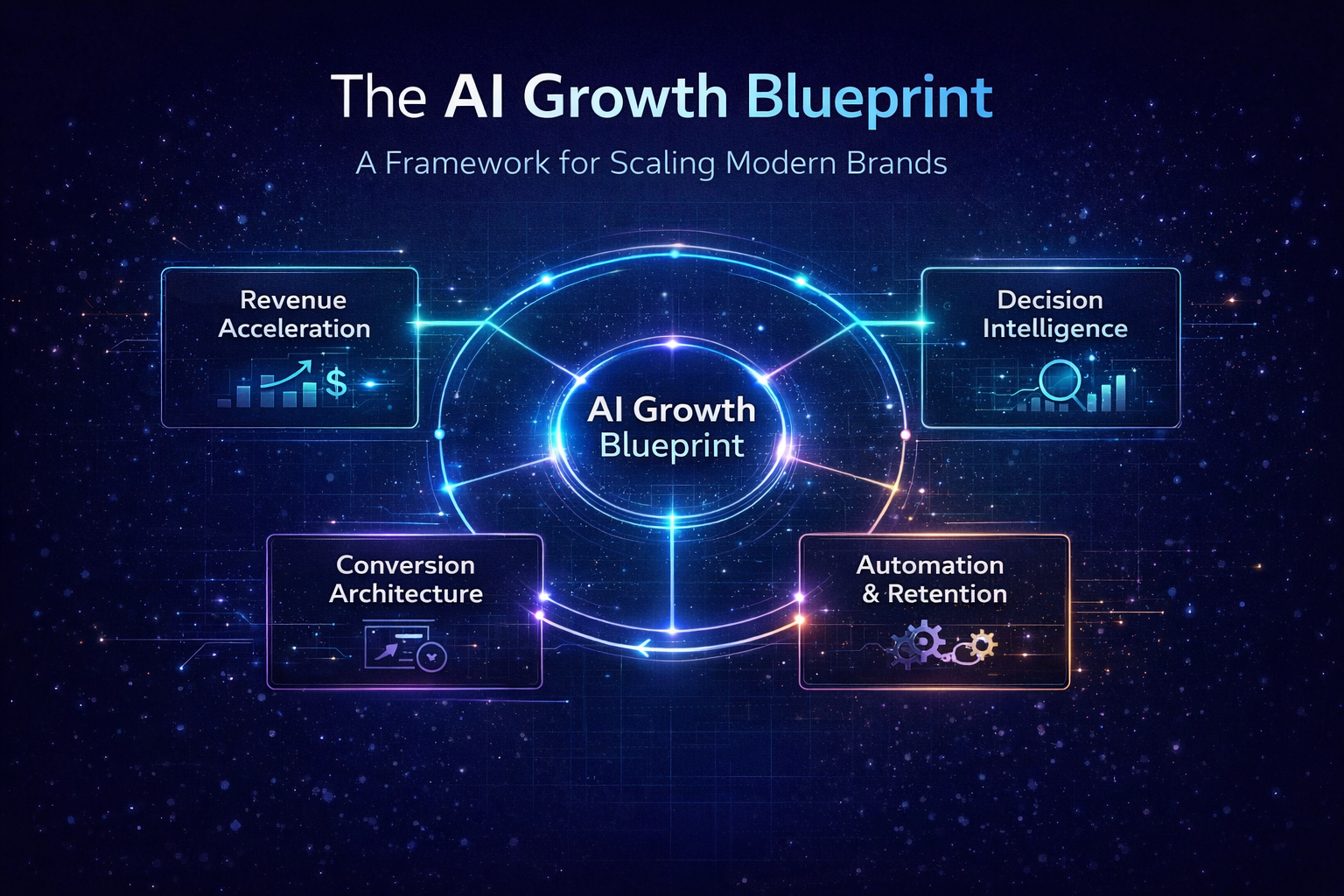
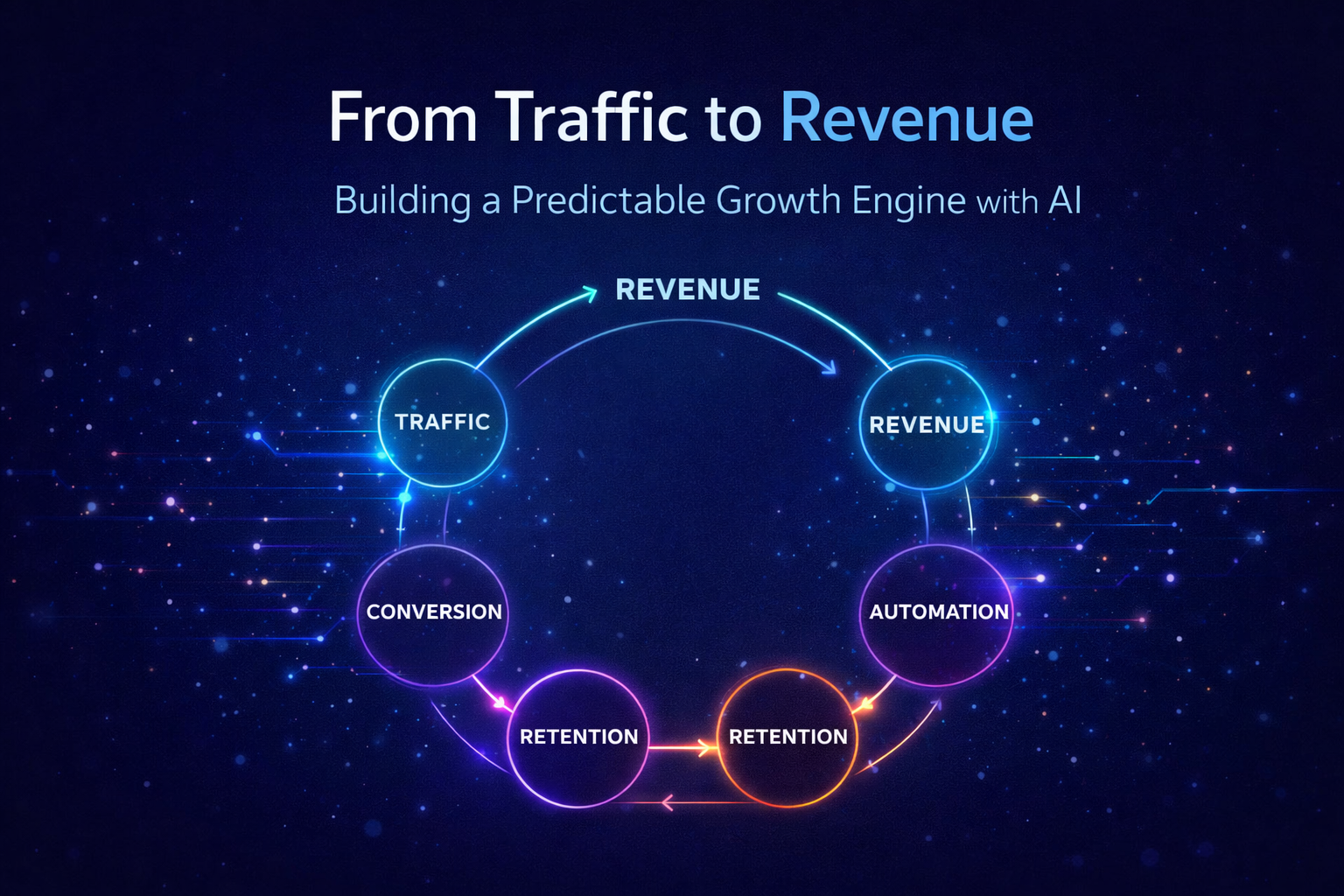
An AI-powered revenue system is a connected marketing framework that integrates:
- Paid acquisition
- SEO and organic growth
- Conversion optimisation
- CRM automation
- Retention systems
- Revenue forecasting
All operating as one measurable growth engine.
This shifts marketing from campaigns to systems.
Traditional Marketing vs AI-Powered Growth
| Traditional Marketing | AI-Powered Growth |
|---|---|
| Manual optimisation | Real-time optimisation |
| Channel-based | System-based |
| Static targeting | Dynamic segmentation |
| Delayed reporting | Predictive forecasting |
| Reactive decisions | Data-driven automation |
This shift creates:
- Lower customer acquisition cost
- Higher conversion rates
- Faster scaling decisions
- More predictable revenue
Is AI Replacing Marketers?
No.
AI replaces inefficiency.
The competitive advantage now belongs to businesses that combine:
- Strategic thinking
- Systems architecture
- Data-driven decision-making
- AI-powered optimisation
AI is leverage — not magic.
Final Thought
Most digital marketing fails because it is fragmented.
AI does not simply optimise ads.
It connects:
Traffic → Behaviour → Conversion → Retention → Revenue
When marketing becomes a unified system, revenue becomes predictable.
And predictable revenue changes everything.

Leave a comment: