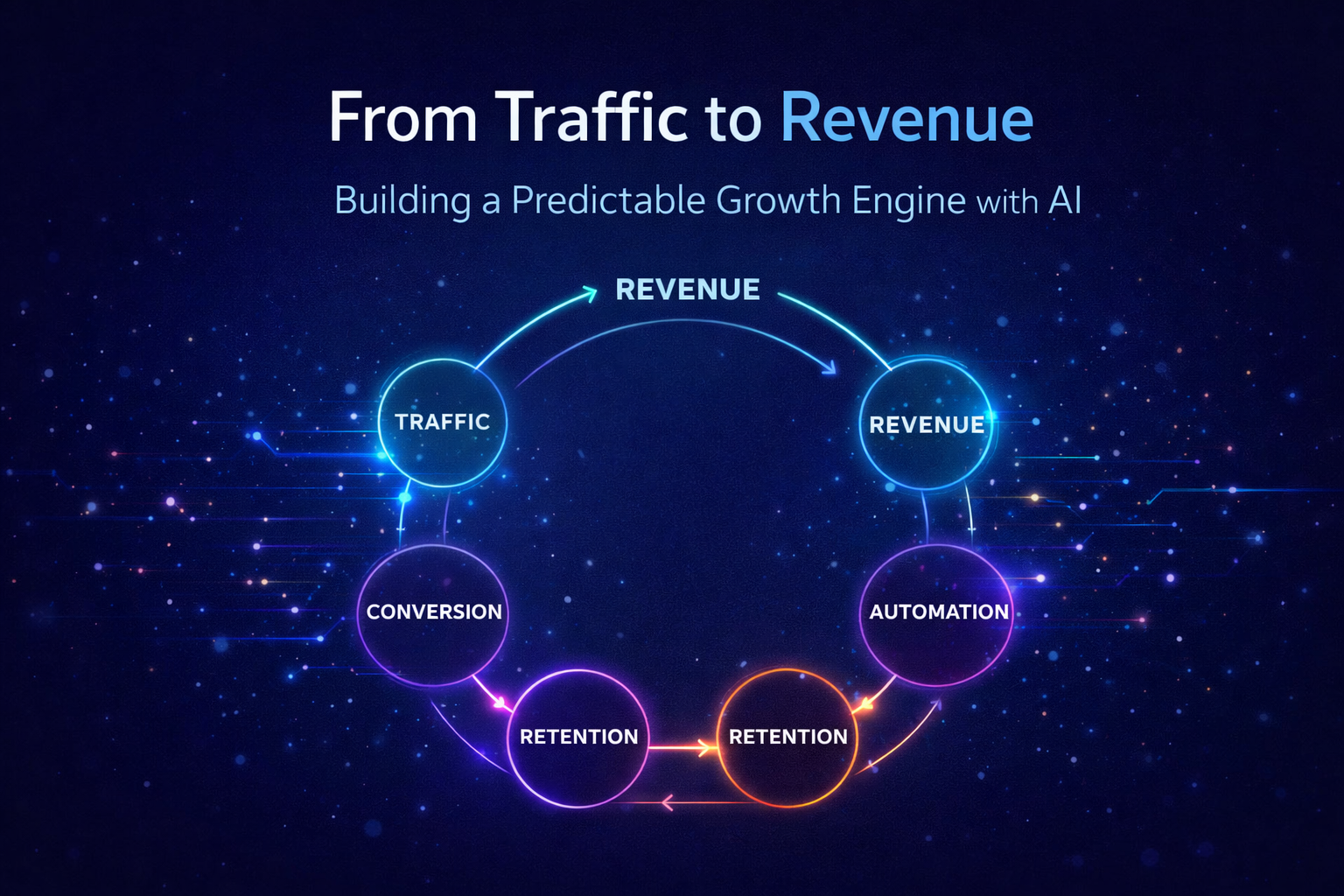
From Traffic to Revenue: Building a Predictable Growth Engine with AI
Traffic is easy to buy.
Revenue is harder to predict.
Most businesses focus on generating more visitors — more ads, more SEO, more social reach. But traffic alone does not create growth.
Revenue becomes predictable only when traffic flows through a structured system.
That system is what we call a Growth Engine.
What Does “Traffic to Revenue” Actually Mean?
Traffic to revenue means converting attention into measurable, repeatable income through structured conversion, automation, and retention systems.
It’s not about getting more visitors.
It’s about ensuring every visitor moves through a defined path toward:
- Conversion
- Upsell
- Retention
- Lifetime value expansion
Without that path, traffic leaks.
Why Traffic Alone Doesn’t Create Growth
Many businesses invest heavily in:
- Paid ads
- SEO campaigns
- Influencer marketing
- Content production
But they lack:
- Funnel sequencing
- Behaviour tracking
- Retargeting logic
- CRM automation
- Revenue forecasting
The result?
Spikes in sales.
Followed by instability.
Traffic creates noise.
Systems create revenue.
What Is a Predictable Growth Engine?
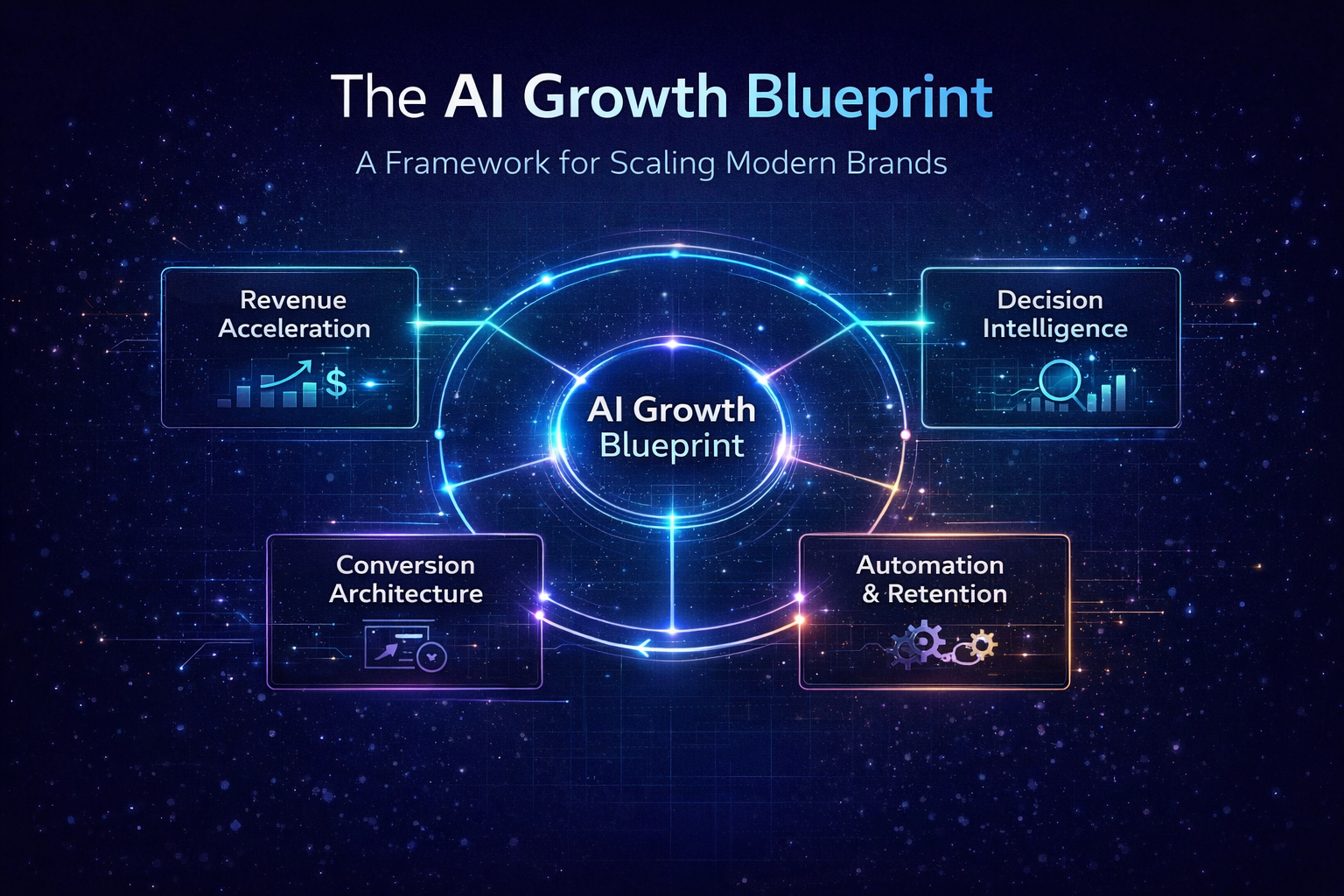
A predictable growth engine is a structured marketing system that integrates:
- Acquisition
- Conversion
- Retention
- Automation
- Revenue forecasting
All connected through data and AI optimisation.
It transforms marketing from campaign-based activity into an adaptive revenue machine.
The 5 Layers of a Predictable AI Growth Engine
1. Smart Acquisition
Acquisition is not about traffic volume.
It’s about acquiring the right users at the right cost.
AI enables:
- Predictive audience segmentation
- Budget allocation optimisation
- Creative fatigue detection
- Real-time bid adjustments
The goal: Reduce customer acquisition cost (CAC) while improving lead quality.
2. Conversion Infrastructure
Traffic must land inside a structured conversion system.
This includes:
- High-converting landing pages
- Behaviour-based triggers
- Dynamic content personalisation
- Funnel logic
- Conversion rate optimisation (CRO)
AI helps identify drop-off points and optimise micro-conversions in real time.
Higher conversion rate = more revenue without more traffic.
3. Intelligent Automation
Manual follow-up kills scalability.
Automation turns interest into revenue by triggering:
- Email sequences
- SMS reminders
- Abandoned cart recovery
- Upsell offers
- Lead nurturing workflows
AI improves this by predicting:
- Purchase timing
- Churn risk
- High-value customer segments
Automation compounds revenue.
4. Retention & Lifetime Value Expansion
The most profitable growth lever is not acquisition.
It’s retention.
AI-powered retention systems:
- Identify repeat purchase patterns
- Personalise re-engagement offers
- Predict churn probability
- Optimise subscription retention
Increasing customer lifetime value (LTV) stabilises revenue.
5. Revenue Forecasting & Decision Intelligence
Most businesses guess when to scale.
A growth engine uses data to forecast:
- Scaling thresholds
- Budget allocation scenarios
- ROAS sustainability
- Margin impact
AI transforms dashboards into decision systems.
Instead of reporting what happened, it models what will happen.
Traditional Marketing vs Predictable Growth Engine
| Traditional Marketing | Predictable AI Growth Engine |
|---|---|
| Traffic-focused | Revenue-focused |
| Campaign-based | System-based |
| Manual analysis | Automated optimisation |
| Reactive decisions | Predictive forecasting |
| Short-term wins | Compounding growth |
This shift creates stability.
How AI Makes Revenue Predictable
How Does AI Create Predictable Revenue?
AI creates predictable revenue by:
- Identifying high-converting audience segments
- Optimising spend allocation in real time
- Detecting funnel inefficiencies instantly
- Predicting churn and retention opportunities
- Forecasting revenue outcomes before scaling
Predictability reduces risk.
Reduced risk enables confident scaling.
Why Most Businesses Never Build a Growth Engine
They stop at acquisition.
They hire:
- An ads agency
- An SEO consultant
- A CRM specialist
But no one integrates the system.
Without integration, marketing remains fragmented.
Revenue remains volatile.
The Revenue Engine Mindset Shift
To move from traffic to revenue, you must shift from:
“I need more traffic.”
To:
“I need a system that converts, retains, and forecasts revenue.”
Growth becomes predictable when:
Traffic → Conversion → Automation → Retention → Forecasting
operate as one loop.
That loop is the engine.
Frequently Asked Questions
What is predictable revenue in marketing?
Predictable revenue is income that can be forecasted based on stable acquisition cost, consistent conversion rates, strong retention, and data-driven optimisation.
Can small businesses build a growth engine?
Yes. Modern AI tools make acquisition, automation, and forecasting accessible even for SMEs.
Is AI necessary for predictable growth?
AI is not mandatory, but it dramatically increases speed, efficiency, and decision accuracy in scaling marketing systems.
Final Thought
Traffic is fuel.
But without an engine, fuel does nothing.
An AI-powered growth engine transforms traffic into compounding revenue — consistently, measurably, and predictably.
That is the difference between marketing activity and growth architecture.

Leave a comment: